

Plumbers in Cincinnati, Ohio: repairs, water heaters and drains
We handle water heaters, drains, leaks and sewer lines in Cincinnati. Greater Cincinnati Water Works supplies the city at roughly 7 to 8 grains per gallon, which is moderately hard. We answer the plumbing emergency line at any hour.
The same team you trust with your furnace now handles water heaters, drains, leaks, and sump pumps — with the same upfront pricing.
What plumbing work do you handle?
Our plumbers are licensed in Ohio, license #13557.
How hard is Cincinnati's water?
Greater Cincinnati Water Works reports about 125 mg/L at the Richard Miller plant and about 138 mg/L at the Charles M. Bolton plant, roughly 7 to 8 grains per gallon. That is softer than the untreated groundwater north of the city and soft enough that many Cincinnati houses run fine without a softener. It is not soft enough to ignore, and water heater scale still shows up on a ten-year-old tank.
Who issues plumbing permits in Cincinnati?
The City of Cincinnati Department of Buildings & Inspections, from the permit center at 805 Central Ave, Suite 500. Work has to comply with the Cincinnati Zoning Code and the Residential Code of Ohio.
The water bill jumped and nothing looks wet. What now?
Read the meter with everything in the house off. If it is still moving, you have a leak on the pressurised side and it is running somewhere you cannot see, usually under a slab, behind a wall, or in the line between the meter and the house. Before assuming the worst, rule out the toilets: a flapper that is not seating will run silently and waste more water than most people believe. Put a few drops of food coloring in the tank and wait twenty minutes without flushing. Color in the bowl means you found it.
The water pressure has dropped. Where do I start?
First work out whether it is the whole house or one fixture, because that splits the problem in half. One fixture is almost always an aerator or a cartridge, and both are small jobs. Whole house points at the pressure regulator, a partly closed main valve, or galvanized supply pipe that has corroded closed from the inside over decades. That last one is common in pre-war houses and it is progressive, so pressure that has been slowly falling for years is telling you something different from pressure that dropped last week.
A toilet that runs on and off by itself. Serious?
It is called phantom flushing and it means water is escaping from the tank into the bowl, so the fill valve keeps topping it up. The culprit is nearly always the flapper, which hardens with age and stops sealing, and it is one of the cheapest parts in the house. It is worth fixing quickly rather than living with, because it runs continuously and quietly, and a running toilet shows up on the water bill at a scale that surprises people who assumed it was just a noise.
Is a tankless water heater worth it?
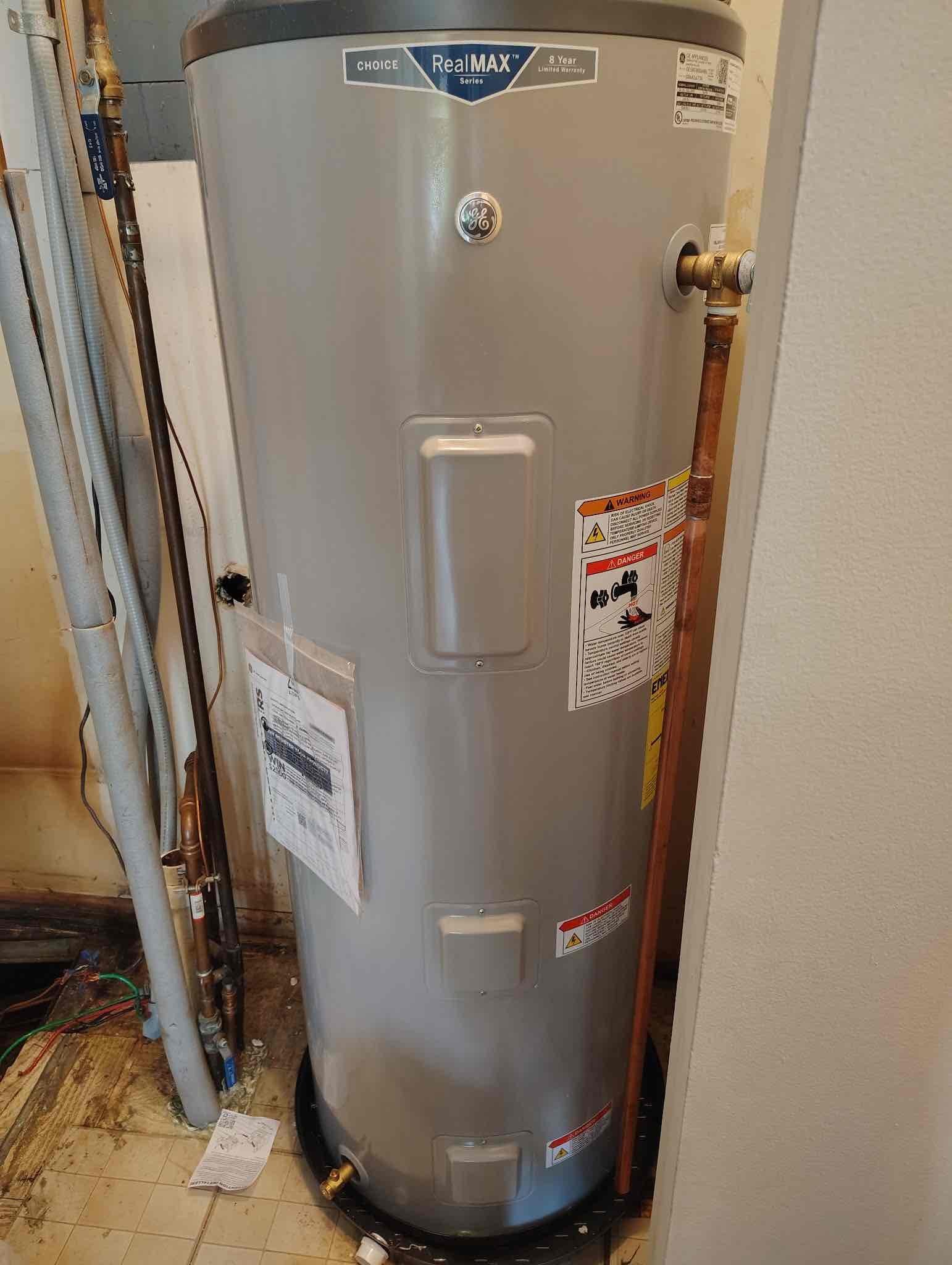
It depends on the house more than on the technology. Tankless gives you hot water that does not run out and takes up far less room, and it lasts longer than a tank. Against that, it usually needs a larger gas line and different venting, so the install is a bigger job than a straight tank swap. It also wants descaling on a schedule in water as hard as ours, and skipping that is how people end up disappointed. If you are replacing in an emergency with no hot water in the house, a tank is usually the faster answer.
Same trucks. Same standards. Now with pipes.
- ✓Licensed and insured plumbers on every job.
- ✓Same-day water-heater swaps in most cases.
- ✓On camera drain and sewer work you can see for yourself.
How do I book a plumber?
Call (844) 584-7399 and you get a person, or book online in about a minute. If it's an emergency, no heat or water on the floor, call rather than booking. That skips the next-day queue and goes straight to the 24/7 line.