

Cleaner ducts, cleaner air in Waynesville
We clean supply ducts, returns, blower compartments and dryer vents in Waynesville, Ohio. A camera goes into your ductwork before we quote anything. Most calls get handled the same day, and someone answers the emergency line at any hour.
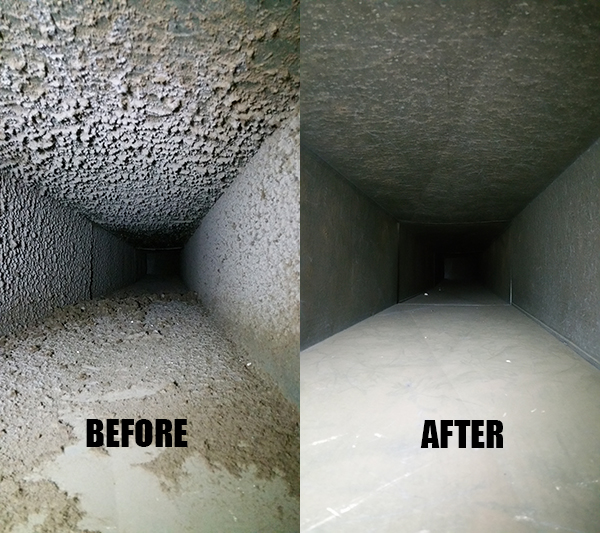
Whole-home duct cleaning with negative-pressure equipment — and before/after photos so you can see exactly what you paid for.
The whole system — not just the vents you can see.
What should I ask to see afterwards?
Before and after photographs of the same locations, including inside the trunk lines and the blower compartment rather than only the register boots. Any company doing this properly expects to be asked and will have them. Two photographs of a register cover prove very little. This is the simplest protection against paying for the version of this job that consists of a vacuum at each vent and an invoice, which is common enough in this trade to be worth guarding against.
Something has been living in the ductwork.
Then cleaning is genuinely warranted, and it is not the first step. The entry point has to be found and closed first, or you are cleaning a duct that gets reoccupied. Nesting material, droppings and the smell that comes with them do belong out of a system that blows into bedrooms, and this is the scenario where duct cleaning is unambiguously worth the money. Expect the job to include the return side, which is usually where they get in.
How do I know if my ducts actually need cleaning?
Take a register cover off and look, and take a photo of what you see. Some settled dust on the bottom of the duct is normal in any house. What is not normal is a visible layer coating the sides, debris you can identify like drywall dust or insulation, anything that looks like nesting material, or a smell that turns up when the system starts and fades when it stops. Ask any contractor to show you inside your own ducts before quoting, and be wary of one who quotes without looking.
Is the dryer vent worth doing at the same time?
It is the one in this category with a genuine safety case, and it is often the more urgent of the two. Lint accumulates in the duct run rather than in the trap, and a restricted dryer vent is both a fire risk and the reason a load takes three cycles to dry. The signs are clothes still damp on a normal cycle, the outside of the dryer running hot, or a flap outside that no longer opens properly. Long runs and runs with several elbows need it more often than short straight ones.